Once again, it’s been confirmed that the WPX Contest has the best contest format for our local conditions. But let’s start from the beginning…
Preparing for a contest involves several stages, especially when it’s a contest that the operator—or rather, the category, in my case—hasn’t participated in before and has no prior experience with. So, I study the available logs and statistics and familiarize myself with the current signal propagation conditions. And I have to tailor all of that to the power output, time limit, and capabilities of the equipment and the operator. Does that sound like a highly specialized endeavor? Yes, it certainly is—you can bet on it!
I love long contests that test a person’s mental and physical endurance. You might ask, what’s 30 hours? Think of it in terms of a workweek—how would you manage to work two 15-hour days? Choosing those 30 hours out of 48 is therefore challenging—you have to take the person into account while also planning breaks so that your score doesn’t suffer. A poor choice of timing can easily cause you to miss the opening of a time zone—and thus lose valuable points and multipliers.
 Distribution of contacts by continent
I’m running SOAB LP assisted with SO2R and a remote station. A technically clever solution that allows me to be on two bands at the same time (almost simultaneously). The local antenna, a Diamond W-8010, is a bit of a letdown. The PSV is unusually high on 40m, 20m, and 15m. The remote station, however, is working great.
Saturday’s propagation conditions on the upper bands—a disappointment. The much-anticipated Japanese contacts didn’t materialize… though it’s not their fault (I hope, heh). Europe, however, is relatively rich in multipliers in the WPX; practically every other contact is a multiplier. In the afternoon, stations from across the Atlantic started appearing, and every one that worked me earned a thank-you via DX spot. Sunday’s propagation conditions are much better! It’s still not perfect—the VE7CC software is flashing “Minor blackouts” in red, and I’m getting an email alert about the aurora… Still, it looks more interesting; I’m logging JM1, JR3, BA2, BA7, JA1, RW0, JF2, JG3—multipliers. In the afternoon, I notice an improvement in PSV on the local 40-meter antenna, so I’m making connection after connection there. Although these are just routine contacts, they’re attractive thanks to the point bonus. And since I’m operating in SO2R mode, I’m actually not losing anything—I’m only gaining!
 10-meter Contact Statistics for CQ WPX RTTY 2014
 15-meter Contact Statistics for CQ WPX RTTY 2014
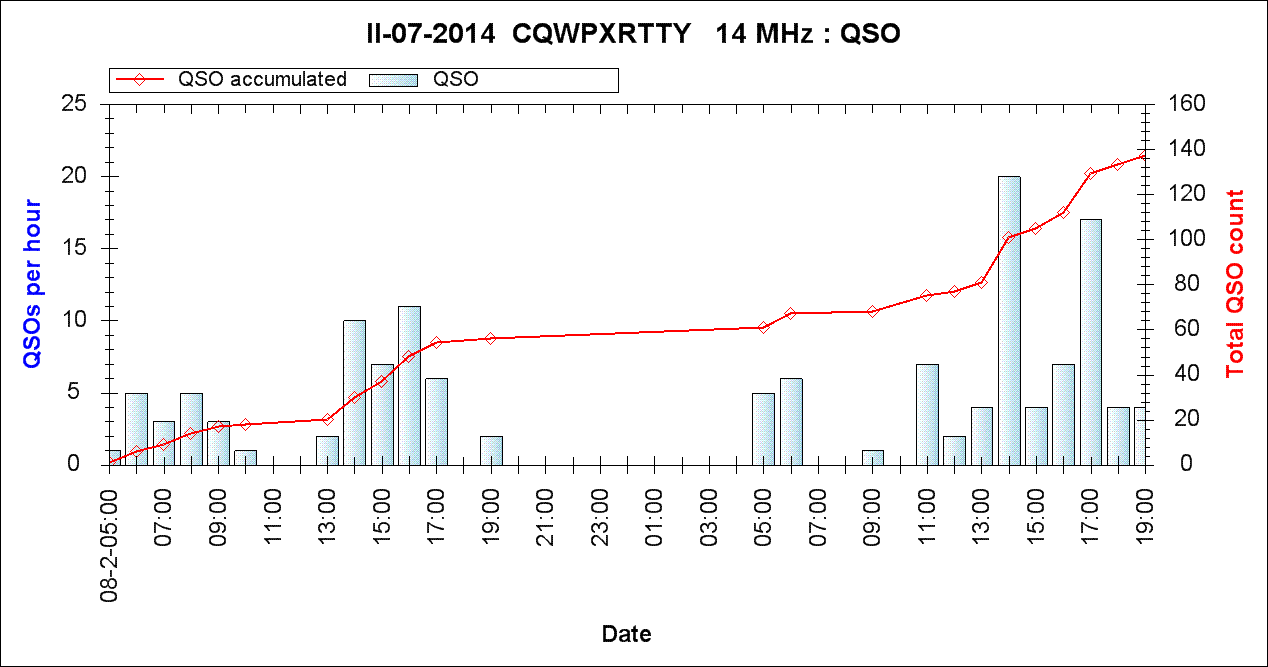 Connection statistics on 20m in CQ WPX RTTY 2014
 Connection statistics on 40m in CQ WPX RTTY 2014
 80m Contact Statistics for the CQ WPX RTTY 2014
 OM0A Contact Statistics for the CQ WPX RTTY 2014
Before the contest, the estimate was 750 contacts and one million points; after 30 hours of operation, the log shows 837 contacts and 1.34 million points. Thanks for the great fun, and I look forward to seeing you at future RTTY contests!