The game is over—CQWW 2012 is behind us! How was this contest?
How the contest plays out is determined by your initial choice of category. This year, I chose SOSB40 LP—that is, a single band with low power and no DX cluster. I usually use a cluster and at least a little more power in contests, so I was curious to see how it would go.
I prepared a special “weapon” for the contest—a 2-element inverted V-beam. Setting up this type of antenna can be done by a single person. Paradoxically, switching antennas caused a few complications. The FT-1000MP control unit cannot switch antenna connectors. The solution is to use a switch on the LPT port. The isolator is an ULN2003 IC, and the software is Remote LPT. The beam thus complemented the standard vertical antenna.
The EI6DX Contest Analyzer (http://www.ei6dx.com/cqww-contest-analysis/cqww-activity-analyzer/) helped with strategy by indicating the best times for operation. I focused on contacts with North America. Part of the mandatory contest preparation is also reviewing the operating announcements at http://www.ng3k.com/. I noticed that some stations were using the Live Contest Score server, so I joined them at http://cqcontest.ru/readscore.jsp. It’s a great motivator to see how others are doing!
The start of the contest wasn’t very encouraging—lots of stations and a lot of interference. All contacts were S&P; calling didn’t work. I concentrated on finding multipliers. The assumption that the number of contacts would catch up thanks to contacts with the EU was confirmed in the morning, when a small pile-up formed on callsign. In the late afternoon, contacts were coming in more slowly, and some interesting multipliers appeared. Zone 25, however, was a lot of work—others were also interested in Japan. HS0, BD, YE, and AH0 are also here, but the DX cluster effect triggers an avalanche of callers, which reduces the chance of making a QSO. A60A and 9K2HN, however, made it into the log easily.
Toward the west, the 2-element inverted V-beam was a great help—we managed to make some multipliers on the first call. The weather, however, caused some trouble; freezing rain shifted the antenna’s resonant frequency lower, so it was usable only in the 7050–7120 kHz range. That was a bit of a bummer, since NA stations are right at the top of the band! There were also some minor outages on the link to the remote station, but fortunately nothing serious.
By morning, I had almost matched OM7KW’s current record. I also managed to almost catch up in the number of multipliers. The behavior of stations on 40m in the early evening is different from the first evening—new stations are appearing that operate on multiple bands and save this band for last. The last multiplier I made was 403A; it’s a shame, though, that I missed TF3W and 9V1YC, who were coming in clearly.
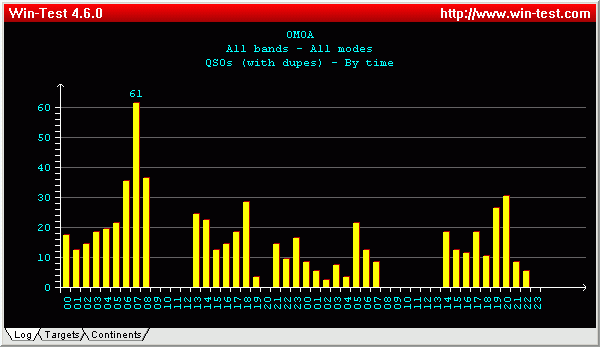 CQWW 2012 Contact Statistics
 CQWW 2012 Point Statistics
 CQWW 2012 Multiplier Statistics
Due to fatigue, I skipped the final hour of the contest; my log shows 596 contacts to 18 zones and 74 DXCCs, totaling 68,727 points. It was impressive to compare my score via the live score with PY6TS, who, despite having a significantly lower number of contacts, nearly surpassed 100,000 points.
Thanks to everyone who responded to the OM0A call or included this call sign in their own callsign. GL!