The July round of the SSB League is special, that the deadline falls on a weekend, when Field Day is held at VKV and at the same time it is the beginning of the holidays. Many radio amateurs are thus out of their QTH. It requires more care when exchanging code, which includes the district coat of arms.

From experience, I can estimate the number of connections after an hour of operation after a few minutes. Števo OM7KW also has very good estimates. It starts at 3756 kHz, I'm launching a challenge about 2 kHz above. Some signals are bordering on noise and interference. The intelligibility of some sessions is not 100%, but by the voice and fragments of the brand it can be detected in stable participants of the race, who broadcasts. It is the same with the exchanged code. I had the most trouble connecting with Rudo OM8SL.
"Please station OM?“
"shhh….shhh…. SL“
“That could be OK1WSL?“
“…..shhh…shh. SL“
(a hint will be heard: OM8SL)
„OM8SL Love 59 TNC“
„OM8SL 59 LISTEN LISTEN"

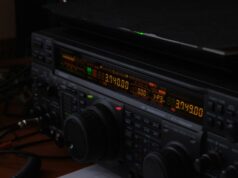
That district was understandable, but without that hint I wouldn't have understood the OM8SL brand at that point. This is also what summer propagation conditions are about. However, it seems, that radio amateurs are also attacked by the plague: creeping noise and crackle of other electrical devices. Unfortunately, in the jungle of electrical equipment, the amateur radio station is that equipment, which is the most difficult to defend. That's how you know it, that the S-meter signal shows several degrees while there is no discernible signal on the frequency. According to the S-meter on my Yaesu FT-1000MP, it sometimes even reaches S8 at 80m.
It was visible, that there are fewer stations. Several stations responded to the challenge, which usually do not have "wide elbows". At the end of the class, I collected a few more stations as a challenge. So they are registered 90 contacts, which the beginning of the SSB League did not show. I guessed 80 to 85 contacts.