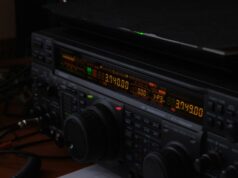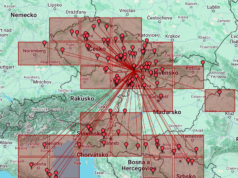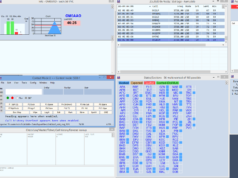

I start by searching for stations from 3700 kHz. Everyone answers the first call. They 3745 kHz, but it changes, I'm trying OM3KEG and OM3SEM, but I have to call these stations 5 times, before my turn. Similarly, other stations in the upper part of po 3770 kHz. I'll try to tune again and call the stations, which I don't have.
You will read:
HINT: advantage of the SDR spectrum
For stations going to the challenge at a high pace, the SDR spectrum can also be counterproductive. The operator has to monitor data more and during the race, where the data in the spectrum is not combined with the mark from the DX cluster, it is also difficult to verify, what station is on the given frequency.

But for stations with a lower tempo or on bands, where it is necessary to monitor the opening of the band, the SDR spectrum is definitely an advantage.
It can also be an advantage when you are looking for a free frequency to call.
Call for 3715 kHz
This is exactly how I managed to find a free frequency 3715 kHz and started calling stations. Not at a high pace, but relatively constant. Both the connections and the multipliers started to increase.
HINT: a strong counter station signal will increase attractiveness
With QRP performance you can't make assumptions, that the signal at the counter stations will be strong enough, so that it is not overlooked during rapid band tuning. Well, they probably won't miss the signal of the QRO station, station, with which the connection is taking place. So it is ideal, to make the QRP station session shorter than the QRO station session.
Changing conditions of propagation

With the approaching conclusion of the OM Activity Contest, there was something to look forward to, that the signals are getting weaker. Station, which have the opportunity to go to the challenge from the first minutes have an advantage in this. However, in the end there is less interference between stations and more free frequencies.
After that, as interference increased to 3715 kHz from the station, which apparently she didn't hear me, I started searching again. New stations have been added to the log, for example OK2YB:
Miro is a stable participant in the OM Activity Contest OM3ZU:
I also try the challenge on different frequencies. It doesn't work somewhere. But in the end, I'm lucky. They manage to find the frequency and they call or increase it number of connections on the finite 62 at 25 multipliers. One is missing: R.